
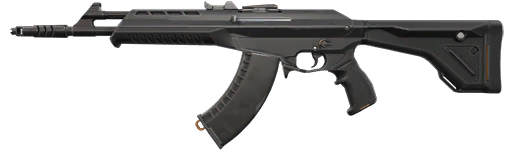
Vandal
Assault Rifles · 2900 Credits
Weapon Stats
Damage by Range
| Range | Head | Body | Legs |
|---|---|---|---|
| 0m+ | 160 | 40 | 34 |
Shots to Kill
| Range | Head | Body | Legs |
|---|---|---|---|
| 0m+ | 1 | 3 | 3 |
| Range | Head | Body | Legs |
|---|---|---|---|
| 0m+ | 1 | 4 | 5 |
| Range | Head | Body | Legs |
|---|---|---|---|
| 0m+ | 1 | 1 | 1 |
Role & Identity
The Vandal is Valorant's flat-damage rifle: a single damage bracket that covers the entire 0-50 meter range, meaning a headshot kills in one shot whether the fight happens across a hallway or across Bind's long A lane. There's no falloff to think about and no mental math about whether the engagement distance costs you a shot — if the crosshair is on the head, the round is over.
That consistency is the whole pitch. Where other rifles trade damage for a bigger magazine or a faster fire rate, the Vandal just commits to the one-shot headshot at every range and lets the player build around that. It rewards clean aim over spray control, since a single well-placed shot ends most engagements before recoil ever becomes a factor.
It's also the rifle most associated with a controlled, tap-and-reset firing rhythm rather than holding the trigger down — the recoil pattern rewards discrete single shots or short two-to-three round bursts far more than a long continuous spray, which is part of why players who favor precision over volume tend to gravitate toward it over the Phantom.
Strengths & Weaknesses
The 25-round magazine and 9.75 rounds-per-second fire rate sit in the middle of the rifle tier — not the fastest, not the slowest — so the Vandal doesn't win fights through sheer volume of fire the way the Phantom's larger magazine can. Its case is made entirely on one-shot potential and Medium wall penetration, which is enough to punish players holding behind thin cover (wood, drywall, car doors) without being reliable through the thicker stone and metal that High-penetration weapons shred.
The tradeoff shows up in spray transfers and multi-target situations. A missed first shot against two stacked enemies is more costly on the Vandal than on a rifle with a bigger magazine and gentler recoil pattern, since the first-bullet miss has already spent a meaningful chunk of the clip's margin for error.
It's also less forgiving of imprecise crosshair placement than a weapon with graceful recoil recovery — the Vandal's pattern climbs quickly if a player tries to hold down full-auto fire across a long engagement, so its real damage ceiling is only realized by a player already comfortable resetting their aim between bursts rather than fighting the recoil in real time.
Economy & When to Buy
At 2,900 credits, the Vandal is a full-buy weapon — it needs a round where your team has the economy for a rifle plus shields plus utility, which usually means winning the previous round or having banked credits from a loss bonus streak. It is not an eco or half-buy option; going for it without shields undercuts the entire reason to spend that much, since the extra HP buffer is what turns close-range trades in your favor against an SMG or shotgun rush.
Because the one-shot kill holds at every range, the Vandal is the safer full-buy pick for maps and positions with long sightlines — Bind's long corners, Haven's C long, Ascent's mid — where a falloff-heavy weapon would ask the shooter to compensate for reduced headshot damage at distance.
It's also worth considering relative to your own team composition: a team already leaning on flat, range-agnostic damage from something like a Guardian or an Operator player benefits less from a second Vandal than a team that has nobody else covering long sightlines, where the Vandal's consistency at range fills a real gap.
How to Play It
The Vandal rewards a patient, angle-holding style more than constant movement, since its value is entirely in the first shot landing clean. Players who like to pre-aim a common angle and take a single confirmed shot rather than spray-check corners tend to get the most out of it — the flat one-shot-kill profile means there is rarely a reason to hold anything other than head height.
It pairs naturally with the entry duelists and anchors who need reliable one-taps on wide-open maps, and with any role that has to hold a long angle solo on defense, where a falloff weapon would be a real liability against someone peeking from 40+ meters out.
In practice, that means favoring counter-strafing into a stop before firing rather than shooting on the move, and treating every engagement as a single decisive shot rather than a prolonged trade — the moment a Vandal fight turns into a back-and-forth spray duel, its main advantage over the Phantom has already been given up.
Vandal vs. Phantom
The comparison to the Phantom comes up constantly precisely because the two rifles cost the same and cover the same core role, so the choice usually comes down to map and personal style rather than one being objectively better. On a map dominated by long, open sightlines — Bind's long corners, Haven's C long, Icebox's mid — the Vandal's flat damage removes a variable the Phantom forces you to account for.
On tighter, close-quarters maps or in positions built around retakes and short corridors, the Phantom's bigger magazine and faster fire rate close more of the gap than the Vandal's range consistency is worth, since most fights never reach the distance where the Phantom's falloff actually costs a kill.
Ultimately the honest answer is that both rifles are viable everywhere, and the deciding factor for most players ends up being which recoil pattern and firing rhythm feels more natural to their own aim — there's no map or role where one is a clear mistake to bring instead of the other.
Want to see how your own vandal usage stacks up? Compare your Valorant stats head to head, or browse every other weapon in the game.