
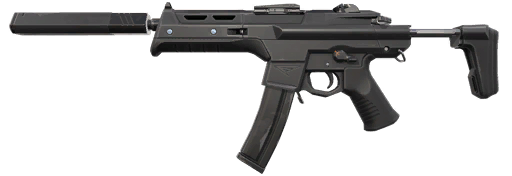
Spectre
SMGs · 1600 Credits
Weapon Stats
Damage by Range
| Range | Head | Body | Legs |
|---|---|---|---|
| 0-15m | 78 | 26 | 22.1 |
| 15-30m | 66 | 22 | 18.7 |
| 30m+ | 60 | 20 | 17 |
Shots to Kill
| Range | Head | Body | Legs |
|---|---|---|---|
| 0-15m | 2 | 4 | 5 |
| 15-30m | 2 | 5 | 6 |
| 30m+ | 2 | 5 | 6 |
| Range | Head | Body | Legs |
|---|---|---|---|
| 0-15m | 2 | 6 | 7 |
| 15-30m | 3 | 7 | 9 |
| 30m+ | 3 | 8 | 9 |
| Range | Head | Body | Legs |
|---|---|---|---|
| 0-15m | 1 | 1 | 2 |
| 15-30m | 1 | 2 | 2 |
| 30m+ | 1 | 2 | 2 |
Role & Identity
The Spectre is the more expensive of the two SMGs at 1,600 credits, with a 30-round magazine and a fast 13.3-round-per-second fire rate. Its damage falls off across three brackets — 78 headshot damage within 15 meters, down to 66 at 15-30 meters, and 60 beyond that — making it a genuine close-to-mid-range weapon rather than a pure point-blank tool.
It's silenced and built for sustained close-quarters spray, functioning as an affordable alternative to a full rifle when a team needs real automatic firepower without the rifle price tag.
The 30-round magazine matches the Phantom's capacity exactly, which is part of why the Spectre is often described as a scaled-down rifle rather than a true SMG in the traditional sense — it can sustain a fight across multiple targets in a way the Stinger's smaller magazine can't.
Strengths & Weaknesses
The combination of magazine size, fire rate, and a genuinely useful mid-range damage bracket (still landing a two-headshot kill at 30 meters) makes the Spectre one of the strongest weapons in its price tier for winning sustained, multi-target fights. It's a real anti-eco tool against a team stuck on pistols or Frenzys.
Low wall penetration and falloff past 15 meters mean it's clearly outclassed by an actual rifle at range — it needs to win fights through volume of fire at moderate distance, not through one-shot precision the way a Vandal or Guardian does.
It's also silenced, which — as with the Ghost — denies an enemy team the visual and audio tracer information that a non-suppressed weapon would give away, a real but easy-to-overlook advantage in coordinated retakes and rotations.
Economy & When to Buy
At 1,600 credits, the Spectre is a strong force-buy or anti-eco pick — cheap enough to fit alongside armor on a rebuilding round, while offering enough sustained damage to beat down a team that's still on pistols or Frenzys from a lost previous round.
It's a common choice specifically when scouting suggests the enemy team is under-bought, since the Spectre's fire rate and magazine size overwhelm cheaper loadouts even without a rifle's one-tap potential.
It's also a reasonable full-team buy on a force round when the economy can't stretch to rifles for everyone but the team wants to contest the round seriously rather than concede it, since it holds up meaningfully better than pistols across the board.
How to Play It
The Spectre wants an aggressive, close-to-mid-range playstyle — pushing through chokepoints and holding fire discipline just long enough to land a full burst rather than relying on a single shot. It rewards spray control more than pure flick aim.
It's a strong pick for entry-focused players on a force-buy round, where clearing multiple close angles in sequence and winning sustained fights matters more than any single precise shot would.
Because its damage is still respectable out to 30 meters, it's worth being a little more willing to engage at moderate range than with the Stinger — the Spectre can meaningfully contest a mid-length hallway in a way a pure close-range SMG can't.
Common Matchups
Against pistols and other force-buy sidearms, the Spectre's fire rate and magazine size generally win a sustained exchange comfortably, which is exactly why it's a favored anti-eco pick.
Against a full rifle at range, the Spectre is clearly behind — the Vandal or Phantom's one-tap potential and better falloff profile win a long-distance duel most of the time, so a Spectre user should look to close distance rather than trade at range.
Against the Stinger specifically, the Spectre's bigger magazine and longer effective range give it a real edge in anything other than a true point-blank exchange, where the Stinger's raw fire rate can occasionally close the gap.
Map & Positioning Notes
The Spectre's mid-range damage bracket makes it a genuinely flexible force-buy pick across most map layouts — it holds up in tight corridors as well as moderate-length hallways, which is part of why it's such a common anti-eco choice regardless of map.
It's a particularly strong choice for a role that expects to take multiple fights while pushing through a site rather than holding one static angle, since the 30-round magazine supports clearing several close-to-mid-range engagements in sequence.
On maps with genuinely long sightlines, it still can't compete with a rifle or sniper, so a Spectre-equipped team on those maps is generally better off planning to win through numbers and utility at closer range rather than contesting the long lane directly.
It also pairs naturally with flashes and other entry utility, since a Spectre user pushing through a smoke or flash into a room can afford to spray-check a corner in a way a single-shot rifle user pushing the same room would be more hesitant to commit to, and the bigger magazine forgives following up on more than one bad read in a row.
Want to see how your own spectre usage stacks up? Compare your Valorant stats head to head, or browse every other weapon in the game.