
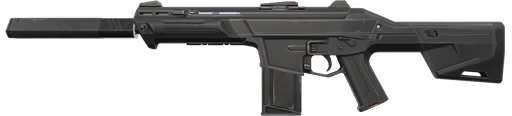
Phantom
Assault Rifles · 2900 Credits
Weapon Stats
Damage by Range
| Range | Head | Body | Legs |
|---|---|---|---|
| 0-20m | 156 | 39 | 33.2 |
| 20m+ | 140 | 35 | 29.8 |
Shots to Kill
| Range | Head | Body | Legs |
|---|---|---|---|
| 0-20m | 1 | 3 | 4 |
| 20m+ | 1 | 3 | 4 |
| Range | Head | Body | Legs |
|---|---|---|---|
| 0-20m | 1 | 4 | 5 |
| 20m+ | 2 | 5 | 6 |
| Range | Head | Body | Legs |
|---|---|---|---|
| 0-20m | 1 | 1 | 1 |
| 20m+ | 1 | 1 | 1 |
Role & Identity
The Phantom is the Vandal's direct rival and the other default full-buy rifle, but it's built around a different bet: a larger 30-round magazine, a faster 11-round-per-second fire rate, and — unlike the Vandal — real damage falloff, dropping from 156 headshot damage inside 20 meters to 140 beyond it. That still kills an unarmored head at any range, but it changes the math against an opponent who already has any prior chip damage, and it's the reason experienced players still talk about 'Phantom range' as a real consideration on long sightlines.
In exchange for that falloff, the Phantom is built to win extended fights and multi-target situations that the Vandal isn't. The bigger magazine means less pressure to make every bullet count, and it's the classic 'no tracers, no kill-feed bullet line' rifle — engagements are quieter to reconstruct for an enemy team watching the kill feed or listening for direction.
The recoil pattern is also gentler and more horizontal than the Vandal's, which is a large part of why it feels more controllable in a sustained spray — a player can hold the trigger down longer before the pattern becomes unpredictable, which suits an aggressive, keep-firing approach rather than the Vandal's tap-and-reset rhythm.
Strengths & Weaknesses
The extra five rounds in the magazine and higher fire rate make the Phantom noticeably better in close-quarters spray fights and against multiple enemies holding the same angle — there is more margin to miss the first shot and still win the exchange. Medium wall penetration matches the Vandal exactly, so neither rifle has an edge shooting through walls.
The cost is precision at range. Past 20 meters the Phantom needs either a headshot at the lower falloff damage or a body shot plus a follow-up to guarantee a kill against a full-health target, where the Vandal simply doesn't have to think about it. On maps with very long sightlines, that difference is real, even if it rarely decides a single engagement on its own.
The lack of a bullet tracer is a genuinely underrated strength worth calling out on its own: on a map where a fight happens in a spot the enemy team can't see directly, a Vandal's visible tracer line can tip off a rotation or a flank in a way the Phantom simply doesn't, which matters more in coordinated play than the raw damage numbers suggest.
Economy & When to Buy
Same price bracket as the Vandal at 2,900 credits and the same full-buy-only logic applies: it wants shields and utility alongside it, not a bare rifle on a half-buy round. Teams that expect to be defending a site at close range, or attacking through tight corridors rather than long lanes, often lean toward the Phantom specifically for the larger magazine and faster kill potential in a crowded room.
It is a slightly more forgiving buy for a player still building consistency, since a miss costs less of the magazine's total capacity than it does on the Vandal — worth factoring in on rounds where aim confidence, not damage profile, is the deciding consideration.
On maps that are mostly tight and close-range — Bind's teleporters and short corners, Fracture's connector rooms — the Phantom's falloff rarely comes into play at all, which tilts the choice further in its favor over the Vandal for a team whose engagements are mostly decided under 20 meters anyway.
How to Play It
The Phantom rewards a more aggressive, run-and-gun approach than the Vandal — pushing through chokepoints, clearing multiple corners in sequence, and relying on the bigger magazine to survive a bad first read. It's a strong pick for entry fraggers who expect to take multiple close fights in a single push rather than hold one angle and wait.
It also suits anyone playing retakes or close-quarters site defense, where fights resolve inside 20 meters most of the time anyway and the falloff distance rarely comes into play — the extra fire rate and magazine size just win more of those exchanges outright.
Because the recoil holds up better under sustained fire, it's also a more natural choice for spray-transferring between two or three targets in a fast-developing multi-kill situation, whereas the Vandal generally rewards resetting the crosshair between each individual kill attempt.
Phantom vs. Vandal
Choosing between the two rifles is less about one being stronger and more about which fights you expect to be in. A team or player who plays close-range entries, retakes, and crowded chokepoints tends to get more consistent value from the Phantom's magazine and fire rate than from the Vandal's flat damage, which matters most on distances the Phantom rarely reaches anyway.
The absence of a visible tracer is also worth weighing beyond pure damage — in coordinated play, giving away less positional information on a missed or unanswered shot has real value that doesn't show up in a stats table but does show up in whether an enemy team can confidently rotate toward a fight.
As with the Vandal's side of this comparison, there's no map where the Phantom is a mistake to bring — it's a genuine coin flip most of the time, decided more by comfort with its recoil pattern than by any hard mechanical edge.
Want to see how your own phantom usage stacks up? Compare your Valorant stats head to head, or browse every other weapon in the game.