
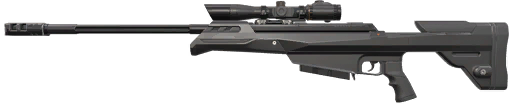
Operator
Sniper Rifles · 4700 Credits
Weapon Stats
Damage by Range
| Range | Head | Body | Legs |
|---|---|---|---|
| 0m+ | 255 | 150 | 120 |
Shots to Kill
| Range | Head | Body | Legs |
|---|---|---|---|
| 0m+ | 1 | 1 | 1 |
| Range | Head | Body | Legs |
|---|---|---|---|
| 0m+ | 1 | 1 | 2 |
| Range | Head | Body | Legs |
|---|---|---|---|
| 0m+ | 1 | 1 | 1 |
Role & Identity
The Operator — 'the Op' — is the most expensive single weapon in Valorant at 4,700 credits, and its damage justifies the price: 255 headshot damage and 150 body damage, both flat across the entire 0-50 meter range. That body-damage number matters as much as the headshot one — 150 damage is enough to kill a fully armored 150 HP target with a single body shot, not just a headshot, at any distance in the game.
That combination — one-shot kill potential on any hit location, at any range — makes the Operator the definitive pick-and-position weapon: a single player holding an angle with it can end a round before an engagement even becomes a fight.
The scoped zoom itself is a defining feature beyond the raw damage — it lets a player positively identify a target and confirm a shot from distances where most other weapons in the game can't reliably distinguish friend from foe, let alone land a kill.
Strengths & Weaknesses
No other weapon guarantees a kill on any body part at any range the way the Operator does. High wall penetration extends that threat through common wallbang spots too, and the scoped zoom lets a skilled player confirm a shot from distances no other weapon can meaningfully contest.
The cost is severe: a bolt-action 0.6 rounds-per-second fire rate means a miss is followed by a long, vulnerable window before the next shot is ready, the 5-round magazine requires a real reload after a poor engagement, and equipping or firing it comes with meaningful movement penalties. Losing an Operator round is one of the most expensive individual mistakes a player can make.
It's also the single easiest weapon in the game to punish with a fast, coordinated push — since a scoped Operator player has reduced peripheral awareness and movement speed, a team that can close distance quickly or attack from an unexpected angle can neutralize its main advantage before a shot is ever fired.
Economy & When to Buy
At 4,700 credits, the Operator is a stacked-economy purchase — it needs a full buy round, ideally with shields, and often makes more sense for one designated player on a team than for multiple players buying it in the same round, since a team can only hold so many long sightlines at once.
Losing the round with an unused or traded Operator is a serious economic setback, so teams typically plan around who holds it and what angle they're covering before the round starts, rather than buying it opportunistically.
It's also common for a team to buy exactly one Operator on a given round rather than several, both because of the cost and because covering multiple long sightlines with the same weapon at once is rarely necessary on a single map.
How to Play It
The Operator rewards pre-aiming a specific angle and staying still — any meaningful movement while scoped costs accuracy, and the whole value of the weapon comes from a confirmed, stationary shot rather than a moving flick. Patience is the entire skill.
It's the signature weapon for a team's designated sniper — usually a player with a calm, methodical style holding one long angle for the whole round rather than rotating through multiple positions the way a rifle player would.
Rotating position after taking a shot, rather than holding the exact same spot, is also an important habit — an enemy team that knows roughly where an Operator shot came from will often immediately push or return fire at that exact location.
Common Matchups
Against a rifle at long range, the Operator wins essentially every exchange where the first shot lands, since neither a Vandal nor a Phantom one-taps a body shot the way the Operator does — the whole matchup comes down to who identifies and fires on the other first.
Up close, the matchup flips hard — the slow fire rate and movement penalty mean an Operator holder caught by a fast SMG or shotgun push at close range is at a severe disadvantage and should generally be trying to create distance rather than stand and trade.
Against another sniper, the deciding factor is usually who has the better angle or the faster reaction, since both weapons kill in one shot regardless of hit location — the Outlaw's faster scope-in can occasionally beat an Operator to the first shot in a genuinely even peek.
Map & Positioning Notes
The Operator is most dangerous on maps with genuinely long, open sightlines — a lane where an opponent has to cross significant open ground gives a stationary Operator holder time to confirm a shot well before any real threat of a close-range push.
On maps that are mostly tight and close-range, its value drops sharply, since there's rarely a long enough angle to justify the cost and the movement penalty becomes a bigger liability than the one-shot-kill potential is worth.
Want to see how your own operator usage stacks up? Compare your Valorant stats head to head, or browse every other weapon in the game.