
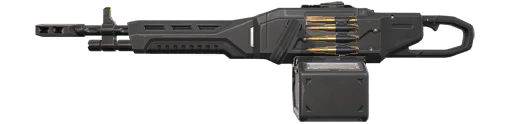
Odin
Heavy Weapons · 3200 Credits
Weapon Stats
Damage by Range
| Range | Head | Body | Legs |
|---|---|---|---|
| 0-30m | 95 | 38 | 32.3 |
| 30m+ | 77.5 | 31 | 26.4 |
Shots to Kill
| Range | Head | Body | Legs |
|---|---|---|---|
| 0-30m | 2 | 3 | 4 |
| 30m+ | 2 | 4 | 4 |
| Range | Head | Body | Legs |
|---|---|---|---|
| 0-30m | 2 | 4 | 5 |
| 30m+ | 2 | 5 | 6 |
| Range | Head | Body | Legs |
|---|---|---|---|
| 0-30m | 1 | 1 | 1 |
| 30m+ | 1 | 1 | 1 |
Role & Identity
The Odin is the top of the heavy weapons tier: a 100-round magazine, the largest in the game by a wide margin, at a 12-round-per-second fire rate. Its headshot damage (95 within 30 meters, 77.5 beyond it) is just short of a guaranteed one-tap on an unarmored target, so the realistic kill pattern is two headshots or a headshot-plus-body combination rather than a single clean pick.
What the Odin actually sells is suppression and sustained fire in a single direction — holding down a chokepoint or a doorway with enough ammunition that reloading mid-fight is almost never the concern it is for every other weapon in the game.
It also carries a well-documented spin-up behavior shared with the Ares, where the weapon's accuracy and effective output improve the longer a single burst of sustained fire is held — a mechanical detail that rewards committing to a long spray rather than tapping in short controlled bursts the way most other automatic weapons prefer.
Strengths & Weaknesses
High wall penetration plus a magazine that never realistically runs dry mid-engagement make the Odin uniquely good at denying a contested space — spraying through a common wallbang angle or holding a corner against a full team push without worrying about ammo count. Nothing else in the game lets a player commit to sustained fire this freely.
The cost is mobility and precision. A 0.76 run speed multiplier while equipped is a real penalty, and the lack of a true one-tap means a good headshot alone often isn't enough to end a fight instantly — an opponent with even partial cover can survive the opening shot and reposition. It's also the single most expensive weapon in the game, so a bad round with it is an expensive round.
It's also the loudest, most visible weapon to be caught holding an angle with — the size of the magazine means an enemy team that hears sustained Odin fire from one direction can often infer both the position and the fact that ammunition isn't a near-term concern, which affects how they choose to approach or avoid that angle entirely.
Economy & When to Buy
At 3,200 credits, the Odin is the priciest full buy in Valorant, more than either full-price rifle. It only really makes sense with a stacked economy and a specific plan — usually locking down a single choke or site entrance for a full team, rather than as a general-purpose rifle replacement.
It's a poor pick for a player who expects to be moving and taking multiple duels across the map in a round; the run-speed penalty and lack of a true one-shot kill make it worse than a rifle in open, mobile engagements even at a higher price.
Because of the cost, teams typically only commit to an Odin buy when they've already won enough rounds to comfortably absorb the risk of losing it, and usually only for one designated player holding a specific choke rather than distributing the cost across multiple teammates.
How to Play It
The Odin is at its best held stationary, pre-aimed at a single chokepoint, letting the huge magazine do the work of denying an entire angle rather than chasing kills across the map. It rewards a defensive, area-denial mindset far more than an aggressive one.
It's a strong tool for a Sentinel or Controller anchoring a site alone, where the ability to hold an angle indefinitely without reloading is worth more than the mobility a rifle would offer, and where the team's utility can cover for the lack of a guaranteed one-tap.
Letting the spin-up mechanic ramp up before an enemy is expected to appear — rather than only starting to fire once a target is visible — is the difference between using the Odin as intended and just using it as an expensive rifle with a big magazine.
Common Matchups
In a straight duel against a rifle, the Odin's lack of a guaranteed one-tap is a real disadvantage — a Vandal or Phantom player who lands the first headshot wins the exchange outright, so the Odin depends on volume and wall penetration rather than out-dueling a rifle head-on.
It's at its strongest against a team trying to push a single chokepoint together, where the magazine size lets a lone Odin holder threaten the entire group rather than just the first person through the door — something no rifle can sustain in the same way.
Against another heavy weapon or a shotgun rush at close range, the movement penalty becomes the deciding factor — an Odin holder caught out of position without time to spin up sustained fire is genuinely vulnerable to a fast, close-range push.
Map & Positioning Notes
The Odin is best suited to maps with a small number of clearly defined chokepoints where a team can commit to defending one specific entrance rather than spreading across several open lanes — a single narrow doorway or stairwell is exactly the kind of space its magazine size is built to deny.
On maps with wide-open sites and multiple entry points, the value drops off, since no amount of magazine capacity covers more than one angle at a time, and the run-speed penalty makes rotating between angles far slower than it would be with a rifle.
Want to see how your own odin usage stacks up? Compare your Valorant stats head to head, or browse every other weapon in the game.